Ah, where would we be without Twitter? Actually, don't answer that.
I've had a personal Twitter account for some time, and as soon as I can come up with a username I can live with, I'll set up a work one (answers on the back of a postcard, please...) Initially, I think my sheep-like tendencies were why I got an account - everyone else seemed to be doing it, so I decided I would as well - and over time, more of my friends have headed over there. I don't update very much, mostly using it for seeing what my friends are up to and picking up links to interesting articles. In that regard, I seem to be the user that this article is talking about.
Yes, Twitter can be horribly mundane and boring, but there can also be some interesting debates sparked, and trending topics can tell you what people are talking about. I like Tweets from organisations and from people who know what they're talking about, and I think that having a work account would actually be good for me. At the moment, I have various library people on my following list, and they get mixed up with updates from friends and Radio 4 items.
It's amazing how involved Twitter discussions can get, considering the character limit, and I've noticed that the really intense ones tend to move off-Twitter after a while, because people get frustrated at not being able to make their whole point, so they make a blog post, Tweet the link and so move the discussion over there. Which is, in its way, just as effective.
For me, I'm going to make these 23 Things Things about getting better organisation of my Twitter feeds, and maybe looking at something like Tweetdeck, so that I can see results from multiple Twitter accounts at the same time. Given my history with monitoring programmes that don't run through Firefox (I love my browser!), I don't hold out much hope, but I'm willing to give them a try...
Wednesday, 10 March 2010

Tuesday, 2 March 2010
Joining the dots. Or not
I've had a LinkedIn account for a while, but once again, 23 Things has me updating the gadgets I'd forgotten about, and possibly remembering why I didn't use them in the first place.
The interface at LinkedIn is far from intuitive, but I definitely see the value in having a professional online network, as distinct from those provided by Facebook, Twitter and even Blogger. I know several people have raised concerns about privacy on LinkedIn, which is worth thinking about, but more concerning is that Facebook is also searchable. There's the fairly notorious case of students being hauled up in front of the Proctors because they had pictures of themselves being 'trashed' after exams, something the university authorities frown on (and fine for). I think there's something very useful about it being the first thing that comes up when an employer types your name into a search engine! Because like it or not, that's what happens nowadays.
I've added a few more people to my LinkedIn network and am going to hopefully make better use of it over the next few months. I'm not sure it'll ever be more than a handy sideline for me, but it would be handy to have somewhere that people can see about me without my having to list CV-type-stuff in my blog. That's definitely something to mull over.
The interface at LinkedIn is far from intuitive, but I definitely see the value in having a professional online network, as distinct from those provided by Facebook, Twitter and even Blogger. I know several people have raised concerns about privacy on LinkedIn, which is worth thinking about, but more concerning is that Facebook is also searchable. There's the fairly notorious case of students being hauled up in front of the Proctors because they had pictures of themselves being 'trashed' after exams, something the university authorities frown on (and fine for). I think there's something very useful about it being the first thing that comes up when an employer types your name into a search engine! Because like it or not, that's what happens nowadays.
I've added a few more people to my LinkedIn network and am going to hopefully make better use of it over the next few months. I'm not sure it'll ever be more than a handy sideline for me, but it would be handy to have somewhere that people can see about me without my having to list CV-type-stuff in my blog. That's definitely something to mull over.
Fess up
Okay, I have to be honest at this point and say that I'm not a huge fan of Facebook. It's not that I don't see its value, quite the contrary. When I've lost someone's email address, being able to find it again is terribly useful. It's also handy for keeping track of birthdays and seeing photographs and suchlike, but there's something about the small update window and the sheer volume of...stuff...that gets posted that puts me off Facebook. Not every platform suits everyone, and Facebook is definitely not for me.
On the other hand, I don't think that libraries can ignore the fact that Facebook is HUGELY popular (with people who aren't me), and having a presence can only be helpful. One of the things I do like about the Law Library's Facebook page is how much we can incorporate into one page. There's ways to search our catalogue as well as COPAC and WorldCat, and a widget showing our Delicious links. One of the best bits is that we can use a selective posting thingy to feed our Tweets into Facebook, which means one post puts updates in two places.
One concern I've seen coming up in lots of people's 23 Things blogs is how many different possibilities there are to 'network' using the internet. It's true that there are a plethora of options and that not everything will reach everybody. But I think that's always been true. There's never been a good way to reach everybody, and one of the joys of the internet is that we can connect all the scattered means of communication. We can link together our Blog, Facebook, Twitter, Delicious and LibraryThing accounts in each place, so it doesn't matter where people go, we're there.
That has to be a good thing, doesn't it?
On the other hand, I don't think that libraries can ignore the fact that Facebook is HUGELY popular (with people who aren't me), and having a presence can only be helpful. One of the things I do like about the Law Library's Facebook page is how much we can incorporate into one page. There's ways to search our catalogue as well as COPAC and WorldCat, and a widget showing our Delicious links. One of the best bits is that we can use a selective posting thingy to feed our Tweets into Facebook, which means one post puts updates in two places.
One concern I've seen coming up in lots of people's 23 Things blogs is how many different possibilities there are to 'network' using the internet. It's true that there are a plethora of options and that not everything will reach everybody. But I think that's always been true. There's never been a good way to reach everybody, and one of the joys of the internet is that we can connect all the scattered means of communication. We can link together our Blog, Facebook, Twitter, Delicious and LibraryThing accounts in each place, so it doesn't matter where people go, we're there.
That has to be a good thing, doesn't it?
Thursday, 25 February 2010
Sometimes I go on the internet, but everyone's spelling is so bad it's depressing
Like many other 23 Things bloggers, I'm a big fan of YouTube. It's great when you're trying to remember an advert from ten years ago, or you want lots of funny videos about cats. Personally, I don't watch much 'user generated' content there, mostly because life's too short and there's just too much to keep up with. The BBC has an excellent presence, letting me catch up with little bits of shows rather than having to skim the iPlayer looking for the clip I want. The Muppets channel is also excellent, and hearing Beaker sing Ode To Joy is one of life's little pleasures.
I hadn't encountered YouTube EDU before, and I can see how it would be very useful as well, although I do wonder if it encourages students to stay in bed rather than come to lectures. Call be old-fashioned, but I do think there's something good about having to actually attend in person - I made some great friends that way while I was studying. On the other hand, if your lecturer's style is impenetrable, I can see how it would be useful to be able to go over it at your own speed, and especially for science subjects, where a lecturer can fill six or seven blackboards in the course of an hour, being able to see the talk as well as hear it could be invaluable.
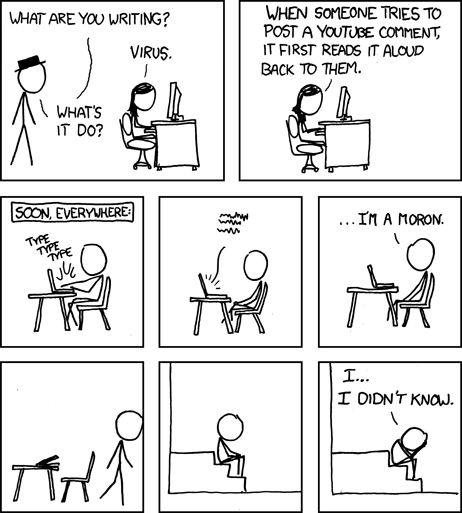
When it comes to comments, YouTube is fairly notorious for being just about the bottom of the barrel, even for the internet. Personally, I don't ever read them, just in case. There's even a Firefox add-on so you don't have to - YouTube Comment Snob actually blocks the comments for you. I also think that, as usual, XKCD has it just about right:
I hadn't encountered YouTube EDU before, and I can see how it would be very useful as well, although I do wonder if it encourages students to stay in bed rather than come to lectures. Call be old-fashioned, but I do think there's something good about having to actually attend in person - I made some great friends that way while I was studying. On the other hand, if your lecturer's style is impenetrable, I can see how it would be useful to be able to go over it at your own speed, and especially for science subjects, where a lecturer can fill six or seven blackboards in the course of an hour, being able to see the talk as well as hear it could be invaluable.
When it comes to comments, YouTube is fairly notorious for being just about the bottom of the barrel, even for the internet. Personally, I don't ever read them, just in case. There's even a Firefox add-on so you don't have to - YouTube Comment Snob actually blocks the comments for you. I also think that, as usual, XKCD has it just about right:
Tuesday, 23 February 2010
Open letter
Dear Blogger,
I was not inclined to love you. It took me long enough to figure out my Livejournal, but at least over there people organise themselves into communities to help one another. I find the independent nature of blogs over here disconcerting, I find the menus hard to navigate, and I never seem to be able to find the option I want when I want it. Having said all that, I was prepared to give you a chance, hoping that the 23 Things programme would let me discover your inner beauty.
I still haven't given up on you completely, and oh, how I love being able to sign into everything with one ID, but if you don't start sending me the damn comment notifications, you and I are going to have a serious falling-out.
No love,
Me.
[later] PS. Okay, so it wasn't entirely your fault. Yahoo thinks your notifications are spam, so at least now I've found them. I'm still yet to be convinced, though. You have 13 more Things to win me over!
I was not inclined to love you. It took me long enough to figure out my Livejournal, but at least over there people organise themselves into communities to help one another. I find the independent nature of blogs over here disconcerting, I find the menus hard to navigate, and I never seem to be able to find the option I want when I want it. Having said all that, I was prepared to give you a chance, hoping that the 23 Things programme would let me discover your inner beauty.
I still haven't given up on you completely, and oh, how I love being able to sign into everything with one ID, but if you don't start sending me the damn comment notifications, you and I are going to have a serious falling-out.
No love,
Me.
[later] PS. Okay, so it wasn't entirely your fault. Yahoo thinks your notifications are spam, so at least now I've found them. I'm still yet to be convinced, though. You have 13 more Things to win me over!
Monday, 22 February 2010
Pod-addicted
My most recent technology purchase was an iPod Touch, a considerable step up from my old, chunky MP3 player. It has lots of fun features, not least an addictive touchscreen game, but undoubtedly the best thing about it is how it handles podcasts. If I'm honest, I don't find iTunes the most instinctive programme in the world, and I have terrible trouble with my music on it since most of them are compilation albums and the tracks all come out in the wrong order. But when it comes to podcasts, iTunes is hard to beat, and they all show up beautifully on my touch.
I have subscriptions to twelve or so Radio 4 podcasts, which is essential for me, since the only thing the Touch doesn't have is a radio. I've been a Radio 4 listener since I was 13, and it's an impossible habit to break, so having something that will easily handle lots and lots of podcasts is just wonderful. In fact, I specifically bought the 32GB version so that I could keep the programmes on there for as long as I wanted.
My favourite podcasts are probably In Our Time and the Friday night comedy, but I also love More or Less and The Bottom Line. I tend not to listen to current affairs ones, since by the time I get round to listening to them, they're usually very out of date. A more recent discovery is iTunes U, and I'm still getting used to that one. The lectures are very good, but they lose something when you can't see the visual aids. Having said that, the Romp Through The History of Philosophy lecture is just brilliant, and I really enjoyed the Reception of Classics one as well. I miss studying, and being able to listen to actual lectures - not just talks/interviews put on for the sake of podcasting - is an absolute joy. My next stop is to investigate the BodCasts and some lectures from other universities, which I also think are a great idea. It'll be interesting to (for example) compare classics teaching here at Oxford to somewhere like Harvard or Sydney. My main problem with this kind of thing is that my eyes are bigger than my ears and things can languish on the 'unlistened to' list for a long time before I remember I've got them. Having said that, I could honestly fill my iPod with just Radio 4 podcasts and 2 or 3 music albums and be happy for months to come.
I have subscriptions to twelve or so Radio 4 podcasts, which is essential for me, since the only thing the Touch doesn't have is a radio. I've been a Radio 4 listener since I was 13, and it's an impossible habit to break, so having something that will easily handle lots and lots of podcasts is just wonderful. In fact, I specifically bought the 32GB version so that I could keep the programmes on there for as long as I wanted.
My favourite podcasts are probably In Our Time and the Friday night comedy, but I also love More or Less and The Bottom Line. I tend not to listen to current affairs ones, since by the time I get round to listening to them, they're usually very out of date. A more recent discovery is iTunes U, and I'm still getting used to that one. The lectures are very good, but they lose something when you can't see the visual aids. Having said that, the Romp Through The History of Philosophy lecture is just brilliant, and I really enjoyed the Reception of Classics one as well. I miss studying, and being able to listen to actual lectures - not just talks/interviews put on for the sake of podcasting - is an absolute joy. My next stop is to investigate the BodCasts and some lectures from other universities, which I also think are a great idea. It'll be interesting to (for example) compare classics teaching here at Oxford to somewhere like Harvard or Sydney. My main problem with this kind of thing is that my eyes are bigger than my ears and things can languish on the 'unlistened to' list for a long time before I remember I've got them. Having said that, I could honestly fill my iPod with just Radio 4 podcasts and 2 or 3 music albums and be happy for months to come.
Sunday, 21 February 2010
Organised serendipity
Another win for Delicious. I save everything in my account, to the point where I barely know what I've got any more. My 'to_read' list is ridiculously long and I've had clearing it out on my to-do list for months.
Anyway, I was saving yet another recipe in there, with my usual 'recipe' tag, when Delicious suggested the tag 'recipe-dairy-free'. Which made me wonder if I'd thought to save the wonderful dairy-free lemon cake recipe that I made last year and subsequently misplaced.
In an unusual stroke of far-mindedness I had done, and can now pass it on to the friend who appreciated it so much! Apparently even when I overload it, Delicious still comes through for me as having a better memory than I do.
Anyway, I was saving yet another recipe in there, with my usual 'recipe' tag, when Delicious suggested the tag 'recipe-dairy-free'. Which made me wonder if I'd thought to save the wonderful dairy-free lemon cake recipe that I made last year and subsequently misplaced.
In an unusual stroke of far-mindedness I had done, and can now pass it on to the friend who appreciated it so much! Apparently even when I overload it, Delicious still comes through for me as having a better memory than I do.
Friday, 19 February 2010
Networking
As I think I said in Thing 9, Delicious Networks aren't really something I've explored very far. I did add the Law Library to my account though, and I had a skim through what my existing network had bookmarked recently. From what I can see, they're mostly looking for pretty pictures and knitting patterns. It could be worse.
I can definitely see the value of a Delicious network, kept in some kind of organised fashion, for a group of people who share interests. If I'm honest, I wouldn't add me to my network, unless I had an interest in randomness gathered on the internet. Actually, put like that, maybe my bookmarks are more entertaining than I think. Through my copious RSS feeds, I gather all kinds of random and interesting webpages. Like people who have a quotation or a song for every occasion, I usually have a webpage for every occasion, or I know where to get one (usually Lifehacker). It's been useful more than once, and I suppose it might be useful to others as well.
Generally though, I would think Delicious networks are best for shared interest groups, or for trusted sources or where you're sure the tagging is consistent. So if you need to stay up to date with Law, adding us to your network so you always know when the latest books on your subject come in is hugely valuable. It might even be a good way for students to share useful websites between themselves. If they're using other collaborative tools (eg Googledocs), it might be a good place to keep links to the various documents and articles for a project - you could just add the project tag and other members of the group could find it.
On the other hand, just adding people at random probably isn't such a good idea. Yes, this is going to be a recurring theme in this blog, but the principles of provenance and authority don't stop applying just because you're on the internet. If anything, with Web 2.0 tools, critical thinking and evaluation are even more important. Either that, or you just accept that you're going to pick up 90% rubbish (you should see some of the things in my GoogleReader), but it's worth it for that 10% gold.
Wednesday, 17 February 2010
Tag! You're it!
I've been intrigued to read people's reactions to Delicious, and thought I'd better write my own thoughts down before I go commenting on other people's blogs.
I am a huge, huge fan of Delicious and use it all the time. The first thing I do when I update my browser or get a new one (I've recently switched from Firefox to Chrome) is to install the Delicious extension, so that I can save bookmarks wherever I am. As mentioned in my photo post below, I move between computers all the time; today, I will be using the one at my desk, the one at the main enquiry desk, my netbook and probably the desktop at home as well. Trying to save bookmarks onto the computer is therefore completely pointless, as they'll be inaccessible to me when I move. By using Delicious, I've always got them, no matter where I'm working.
One of the big complaints I've seen about Delicious is the tagging, and I have to admit that I understand this one. I don't really use my Delicious Network at all (although maybe I should, since my friends always seem to know where to find the cool stuff), and it is frustrating when people have tagged badly or inconsistently. On the other hand, I know plenty of people who are paragons of virtue when it comes to tagging, and it's incredibly easy to find things on the subjects they're interested in.
The other complaint about Delicious has been volume. There is an enormous amount of information on Delicious, how can you possibly find what you want? In all honesty, that's the kind of question you could apply to the whole internet. We all know that it can be tricky to explain to students that not everything they need can be found through Google, or rather that there are quicker and easier ways of finding things. For me, Delicious is much like that. My personal network (different from my work one) consists of people I know and trust to find interesting things. If I'm looking for information, I start with the source that's most likely to know the answer, and that source is not often going to be Delicious. On the other hand, if I'm looking for something good to read, and someone in my network saves book reviews, that would be an excellent place to start. Yes, there are inconsistencies between tagging styles, but most people are internally consistent, and a glance at their tag list will generally show this up. I don't really regard it as any different to evaluating any other source of information:
~ Does this contain the kind of of information I want? If I'm looking for car advice and all the links I can see relate to penguins, then this may not be the place.
~ Is the tagging consistent? If it isn't, then it's going to take me so long to find what I want that I may as well try someone else.
~ What are the sources being linked to? You have to know what kind of information you want - do you want blogs or official websites or book recommendations for further reading.
These are basic questions that librarians don't even think about most of the time, yet it's a critical faculty that tends to fall by the wayside when we start looking at the internet. We look at the volume, the lack of editorial control, the inconsisten approach to structure and assume this means it's not going to be of use. But these are essentially different ways of disseminating information, and there's no need to approach them any differently to any other information source.
Delicious is just a tool for accessing information that other people found useful. If it doesn't suit the way you work, then there are good alternatives. Personally, I find it fascinating to see how other people have tagged information - sometimes that can be as interesting as the information itself! - and while I would never use it as a primary source of information, I can definitely see the value in looking at what other people found useful. As long as I'm still free to evaluate these things for myself, I can definitely see the value in people sharing resources. And cute pictures of cats, which seems to be most of what's on my network at the moment...
I am a huge, huge fan of Delicious and use it all the time. The first thing I do when I update my browser or get a new one (I've recently switched from Firefox to Chrome) is to install the Delicious extension, so that I can save bookmarks wherever I am. As mentioned in my photo post below, I move between computers all the time; today, I will be using the one at my desk, the one at the main enquiry desk, my netbook and probably the desktop at home as well. Trying to save bookmarks onto the computer is therefore completely pointless, as they'll be inaccessible to me when I move. By using Delicious, I've always got them, no matter where I'm working.
One of the big complaints I've seen about Delicious is the tagging, and I have to admit that I understand this one. I don't really use my Delicious Network at all (although maybe I should, since my friends always seem to know where to find the cool stuff), and it is frustrating when people have tagged badly or inconsistently. On the other hand, I know plenty of people who are paragons of virtue when it comes to tagging, and it's incredibly easy to find things on the subjects they're interested in.
The other complaint about Delicious has been volume. There is an enormous amount of information on Delicious, how can you possibly find what you want? In all honesty, that's the kind of question you could apply to the whole internet. We all know that it can be tricky to explain to students that not everything they need can be found through Google, or rather that there are quicker and easier ways of finding things. For me, Delicious is much like that. My personal network (different from my work one) consists of people I know and trust to find interesting things. If I'm looking for information, I start with the source that's most likely to know the answer, and that source is not often going to be Delicious. On the other hand, if I'm looking for something good to read, and someone in my network saves book reviews, that would be an excellent place to start. Yes, there are inconsistencies between tagging styles, but most people are internally consistent, and a glance at their tag list will generally show this up. I don't really regard it as any different to evaluating any other source of information:
~ Does this contain the kind of of information I want? If I'm looking for car advice and all the links I can see relate to penguins, then this may not be the place.
~ Is the tagging consistent? If it isn't, then it's going to take me so long to find what I want that I may as well try someone else.
~ What are the sources being linked to? You have to know what kind of information you want - do you want blogs or official websites or book recommendations for further reading.
These are basic questions that librarians don't even think about most of the time, yet it's a critical faculty that tends to fall by the wayside when we start looking at the internet. We look at the volume, the lack of editorial control, the inconsisten approach to structure and assume this means it's not going to be of use. But these are essentially different ways of disseminating information, and there's no need to approach them any differently to any other information source.
Delicious is just a tool for accessing information that other people found useful. If it doesn't suit the way you work, then there are good alternatives. Personally, I find it fascinating to see how other people have tagged information - sometimes that can be as interesting as the information itself! - and while I would never use it as a primary source of information, I can definitely see the value in looking at what other people found useful. As long as I'm still free to evaluate these things for myself, I can definitely see the value in people sharing resources. And cute pictures of cats, which seems to be most of what's on my network at the moment...
The look of the Thing
Things 7 and 8 were to do with photo editing, which isn't something I feel I have a particular knack for. I love photographs, but I take very bad ones, and I don't really have a good enough eye for colour/style to feel confident doing interesting things to my pictures. So I thought this 'Thing' was going to be fairly quick and simple. I already have a Flickr account, which I use for keeping pictures of my crocheting in, so that didn't need anything doing to it, and I figured I'd just prod at Picnik a little to see what it could do and leave it at that. My photos are already in sets, and although I can see the value of the map feature if you're taking pictures of exotic climes, it's not really much use for crochet! So I thought I'd be able to rattle through these Things in pretty short order.
As usual, I vastly underestimated how much time I can waste on the internet.
As usual, I vastly underestimated how much time I can waste on the internet.
Subscribe to:
Posts (Atom)